
Where 3 : 1 comes from and when it misleads
The ratio between backswing and downswing is treated as a guideline. Behind it is an average measured in good players.
- tempo
- rhythm
- measurement
Anyone who looks into golf tempo eventually runs into the number 3 : 1: the backswing takes roughly three times as long as the downswing. You find it in books and videos, and our app uses it as the default setting. Where it comes from is rarely explained.
An average of observations
3 : 1 is the average of what you measure in players whose swing is considered good. An observation across many swings became a guideline, and as it was passed along, the guideline often became a rule.
But an average only tells you where the middle is. It does not tell you whether a deviation from it is a mistake.
Why we still show two numbers
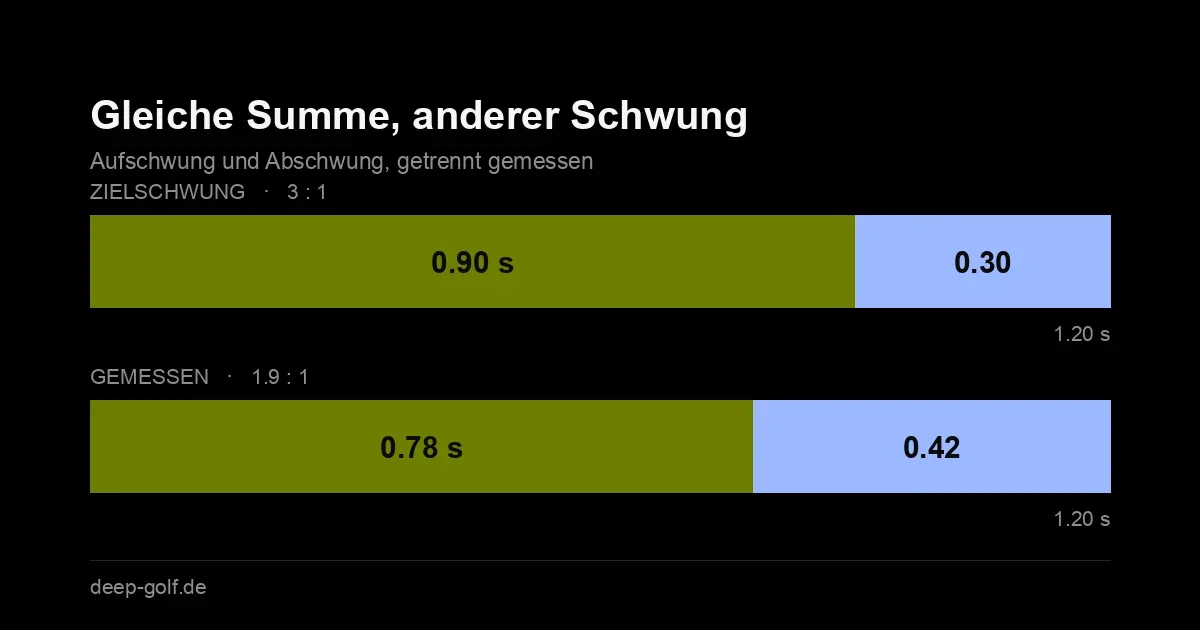
Precisely because the ratio varies, we measure both phases separately. The total time alone hides too much: a swing of 0.78 to 0.42 seconds has the same sum as one of 0.90 to 0.30, but it is a very different swing. You only see that difference when you can look at both times on their own.
What this means for you
Use 3 : 1 as a starting point for your practice. What matters more than the distance to the guideline is how much you scatter around your own value. If your ratio swings between 2.4 and 3.6 across ten shots, that is what to work on. Whether your middle sits at 2.8 or at 3.1 matters less.
On the measurement page you can work through how total time and ratio shape every target value.